


By S B Shaheen, Fragrance Expert at Perfumeo. Last updated October 2026.
Fragrance notes are the individual smells you can pick out of a perfume, listed in three groups according to how quickly they disappear. Top notes go first, heart notes carry the middle, base notes stay longest.
That is the whole answer. The useful part is what the list actually tells you about the bottle in front of you, and what it quietly leaves out.
A note is not an ingredient
This trips up almost everyone, so start here.
A note describes a smell, not a thing in the bottle. When a listing says leather, no leather went anywhere near it. A perfumer built a leather impression out of other materials. The same goes for sea breeze, rain, fresh linen and most fruit beyond citrus. Nobody can extract a usable smell from a strawberry or a peach, so those notes are constructed too.
Even some of the most familiar names are blends rather than materials. Amber is the clearest case. There is no amber plant and no amber tree. Perfumers build it from labdanum resin, benzoin and vanilla, and they have done so for more than a century. We go through twelve of the worst offenders in our guide to confusing fragrance notes explained in three words.
So read a note list as a description of what you will smell, not an ingredients panel. It is closer to a menu than a recipe.
The three layers, and what each one does
Everything comes out of the sprayer at once. The layers are not stacked in the bottle and they do not take turns. You smell them in sequence because they evaporate at different speeds, and the light stuff leaves first.
| Top | Heart | Base | |
| Its job | Grabs you in the first sniff and sells the bottle on the shop floor | Carries the actual character of the fragrance | Holds everything up and leaves the trail behind you |
| How long you smell it | A few minutes up to about half an hour | From roughly half an hour until the fragrance fades | Hours on skin, and days on a scarf or a coat |
| Why it behaves that way | Light, volatile molecules that evaporate fast | Middleweight molecules that sit in between | Heavy molecules that cling and evaporate slowly |
| What usually sits there | Citrus, aromatic herbs, light spice, aquatic accords | Florals, fruit, warm spice, tea, tobacco | Woods, resins, musks, vanilla, amber, oud |
Notice the middle row. Those timings are ranges, not promises, and anyone quoting you exact minutes is guessing. How long a top note lasts depends on the material, the concentration, the weather and your skin. A citrus opening on a hot day can be gone in four minutes. The same spray in January might hang around for twenty.
Why they arrive in that order
The mechanism is physics rather than perfumery magic.
Light, small molecules evaporate quickly, so they reach your nose first and run out first. Heavy molecules evaporate slowly, so they are still working hours later. That is it. Bergamot is near the top of every pyramid because bergamot is volatile. Sandalwood sits at the bottom because sandalwood is not.
Perfumers have worked this way deliberately since the middle of the last century. Jean Carles, who ran the Roure perfumery school in Grasse from 1946 and trained a generation of the people who shaped modern perfume, studied how fast materials evaporate and taught his students to compose from the base upwards. Build something that lasts, then decorate the opening. The triangle diagram you see on product pages came later as a way of showing customers the same idea.
Carles went anosmic towards the end of his life and kept composing from memory, with his son smelling the trials for him. Only his son knew. It is a good reminder that the structure is knowledge, not just instinct.
What a real pyramid looks like
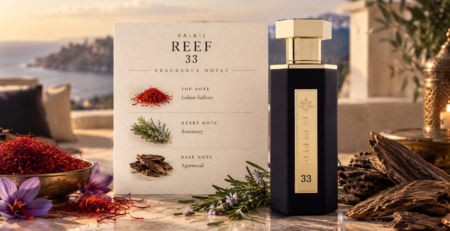
Read that bottom row again. Vanilla, tonka bean, amberwood, myrrh, benzoin and akigalawood are all slow, heavy materials. A fragrance weighted that way is built to last, and this one does. Compare it to something with two base notes and a long list of citrus on top, and you can predict which will still be there at dinner without smelling either.
That is the single most practical thing a note list gives you, and most people never use it.
How to read a note list before you buy
Four things to look for, in order of how much they tell you.
Count the base. A heavy base means longevity. Woods, resins, musks, vanilla, amber and oud all stay put. If the base is thin, expect the fragrance to fade early whatever the marketing claims.
Read the heart, because that is the fragrance. The opening sells bottles and then vanishes. The heart is what you and everyone near you will actually smell for most of the day. If you dislike the heart notes, you will dislike the fragrance, no matter how good the first thirty seconds are.
Ignore the top if you are buying online. It is the least representative part and the first to go. Judging a blind buy on its citrus opening is like judging a meal on the smell of the kitchen.
Watch for one note doing all the work. Plenty of fragrances are essentially one idea with decoration. That is not a criticism, some of the best are, but it tells you whether you are buying something simple and wearable or something that will keep changing on you.
Which notes last the longest
Roughly in order, from most stubborn to least.
- Resins and balsams. Labdanum, benzoin, myrrh and olibanum. These are the anchors, and they are why Arabian perfumery lasts the way it does.
- Woods. Sandalwood, cedar, guaiac and oud. Oud in particular is close to immovable.
- Musks and ambers. Ambroxan and the synthetic musks cling to skin for hours and to fabric for longer.
- Vanilla, tonka and sweet gourmand materials. Heavy and slow.
- Florals. Variable. Jasmine and tuberose hold on, lighter florals do not.
- Fruit and green notes. Short.
- Citrus. Shortest of all, and the reason most fresh fragrances feel like they vanish.
Concentration matters alongside this, and the two get confused constantly. Notes decide the shape, concentration decides the volume. Our guide to perfume strength levels covers that side properly.
How to learn to smell notes
You already can. You simply have not practised naming what you smell, which is a different skill from smelling it.
Start with your kitchen and your garden rather than with perfume. Smell cinnamon on its own. Smell a cut lemon, black pepper, coffee, cloves, a rose, fresh mint. Name each one out loud. This sounds daft and it works, because recognition is about having a labelled memory to match against.
Then take one fragrance you already own and wear it with attention for a full day. Smell your wrist at ten minutes, at an hour, at three hours and at bedtime. You will notice it has changed character each time. Once you have felt that shift on something familiar, the pyramid stops being an abstraction.
Do not try to pick apart six fragrances in one afternoon. Your nose fatigues within a few minutes and everything starts smelling the same. Three is a sensible maximum, with breaks.
Using notes to find what suits you
Work backwards from fragrances you already like.
Pull up the note lists of three bottles you enjoy and look for what repeats. Most people find the same two or three materials turning up every time, usually in the base. That repeated material is your actual preference, and it is far more reliable than any family label like woody or oriental.
Once you know it, you can shop by it. If vanilla and tonka keep appearing, you are a gourmand wearer and you should look there first. If it is cedar and vetiver, you are not, and no amount of sweet bestsellers will convert you.
Some notes also behave as safe bridges across seasons and occasions. Bergamot, cedar, light musk, lavender and vanilla in small doses all sit comfortably almost anywhere. The heavy end, oud, thick resins, tuberose and strong gourmands, rewards you in cold weather and works against you in a warm room.
For a worked example of two fragrances that share four notes out of nineteen and still smell different, see our comparison of Khamrah against Liquid Brun. It shows why the shared list matters less than which layer each note sits in.
What the pyramid does not tell you
Three honest limits, because most guides skip them.
The list is a marketing document. Brands choose what to publish. They leave things out, they include materials in trace amounts because the name sells, and they rarely disclose proportions. Two fragrances can share an identical note list and smell nothing alike, because a formula is about quantity and quality of material, and the pyramid shows neither.
Not every fragrance has three neat layers. Plenty of modern releases are built as a single accord that barely develops, sometimes called a linear fragrance. Some houses publish no pyramid at all. Neither is a failing.
Your skin changes the outcome. Skin chemistry, how oily your skin is and what you ate all shift how a fragrance reads. This is why a bottle smells superb on a friend and ordinary on you. The pyramid cannot account for that, and only wearing it can.
Frequently asked questions
What does fragrance notes mean?
It means the individual smells a perfume is described as having, sorted into three groups by how long each one lasts on skin. The groups are top, heart and base. A note names a smell rather than a physical ingredient, so many notes on a list have no matching raw material in the bottle.
What are the 3 main notes of every fragrance?
Top notes, heart notes and base notes. Top notes are the light materials you smell immediately and lose within half an hour. Heart notes carry the main character through the middle of the wear. Base notes are the heavy materials that last for hours and leave the trail on your clothes.
What does top notes mean in fragrance?
Top notes are the most volatile materials in the composition, which means they evaporate fastest and reach your nose first. They usually include citrus, aromatic herbs and light spice. They are the part that sells a bottle in a shop and the part that tells you least about how the fragrance actually wears.
What are base notes in fragrance?
Base notes are the heaviest, slowest materials in the formula, typically woods, resins, musks, vanilla, amber and oud. They are barely noticeable in the first few minutes, they define the fragrance from a few hours in, and they are what remains on a coat or scarf days later.
How do fragrance notes work?
They work by evaporation rate. Everything is sprayed at once, but light molecules evaporate quickly and heavy ones slowly, so you smell the composition in sequence. The order on a pyramid reflects that physics, which is also why perfumers build from the base upwards.
Which notes last longer in a fragrance?
Resins, woods, musks and vanilla last longest, with oud and labdanum among the most persistent materials in use. Citrus, green and fruit notes fade fastest. A quick guide is to count the base notes on a listing, because a heavy base generally means a long wear.
How do I find the notes of a fragrance?
Check the brand’s own published pyramid first, which usually appears on the box, the official product page or a specialist retailer’s listing. Treat retail listings carefully, because they frequently copy the wrong pyramid across similar releases. Where the brand publishes nothing, nobody else knows either.
What fragrance has the most notes?
There is no official record, and the question is less useful than it sounds. Published note counts reflect what a brand chose to list rather than how complex the formula is. Some compositions with eight listed notes contain far more materials than ones advertising thirty.
Do more notes mean a better fragrance?
No. A long list often means a brand wanted an impressive label. Some of the most admired fragrances are built on three or four materials used well, and some of the most forgettable list twenty. Judge by how it wears, not by the length of the pyramid.
Where to go next
Now that the structure makes sense, these go deeper on the questions people ask next.
- The twelve most confusing fragrance notes, each explained in three words and then properly. Start here if a specific word on a listing is the problem.
- How to identify fragrance notes, a week-long method for training your nose using your own kitchen.
- What fragrance notes go together, the classic pairings and how to find your own signature.
- The best fragrance notes for winter, and why cold air changes everything.
- What fragrance notes do men like, the families that actually sell.
- What fragrance notes women find attractive on men, and what the published research really found.
- What oud actually smells like, the most asked-about note of all.
- Perfume strength levels explained, if your real question is why a fragrance fades before lunch.
About the author
S B Shaheen runs Perfumeo, a UK retailer of Arabian and designer fragrance, and writes the guides published here. He buys and wears the stock the shop sells. Read more about the author.








Leave a Reply