

The short answer
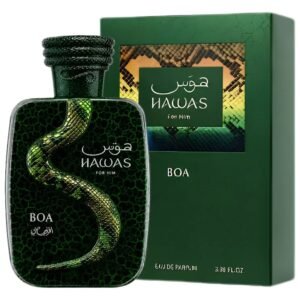
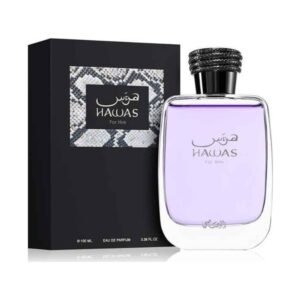
They share a fruit-led opening and a driftwood thread, and almost nothing else. The original Hawas is a sweet salty aquatic that resolves into ambergris and musk. Boa is a bitter tropical fruit that resolves into dry incense and sandalwood. If you own the original and want more of what made you buy it, Boa is not that. If you own the original and want the same house doing something genuinely different, Boa is the clearest example in the range.
- Free DeliveryTracked, on every UK order
- No Minimum SpendEven on a single bottle
- Same Day DispatchOrder before 2pm
Hand-picked by our fragrance team
Sold-out bottles drop off this list automatically. Everything here is ready to ship today.

100% genuine, sealed stock, shipped from our UK warehouse
By S Bin Shaheen, Fragrance Expert at Perfumeo. Last updated October 2026.
Boa is the Hawas people ask about once they already own one. The question is never what it smells like in isolation, it is whether it is different enough from the Hawas already on the shelf to justify a second bottle. That is a harder question than it looks, because the marketing around this line encourages you to assume every flanker is a departure, and most of them are not.
Here is the honest comparison, with both note lists taken from Rasasi’s own published pyramids rather than from retail listings.
The two pyramids side by side
| Hawas (original, 2015) | Hawas Boa (2026) | |
|---|---|---|
| Top | Bergamot, apple, cinnamon, lemon | Madagascar pomelo, prickly pear, green apple, orange blossom |
| Heart | Watery notes, plum, orange blossom, cardamom | Tonka bean, driftwood, Flowerpool, olibanum |
| Base | Ambergris, musk, driftwood, patchouli | Sandalwood, Ambronova, vetiver, vanilla |
Two notes on the lists themselves, because both cause confusion.
Flowerpool is Rasasi’s own name for the floral accord in Boa’s heart. It is not a standard perfumery material and it appears nowhere else in the line, so you will not find it explained anywhere. Treat it as a house floral rather than a specific flower.
Olibanum and frankincense are the same material. Rasasi writes olibanum on its own listings. Independent databases usually write frankincense. If you cross-check Boa elsewhere and think a note has gone missing, that is why.
Where they overlap more than you would think
Both are fruit-forward in the opening, and both contain apple. The original opens on apple against bergamot and lemon, Boa opens on green apple against pomelo and prickly pear. In the first thirty seconds, on paper, a blind sniff would reasonably place them in the same family.
Both also contain driftwood, which is the genuine inherited note between them. The difference is where it sits. In the original it is a base note, part of the salty aquatic finish alongside ambergris. In Boa it is promoted to the heart, where it reads as sun-bleached wood sitting against smoke rather than as part of a marine accord. Same material, completely different job.
Orange blossom appears in both, in the heart of the original and the top of Boa.
Where they split
The split is total and it happens within the first hour.
The original has watery notes and plum in the heart, which is what produces the sweet, slightly aquatic, faintly fruity character people recognise as the Hawas signature. It lands on ambergris, musk and patchouli, which is a clean, salty, skin-close finish.
Boa has olibanum in the heart, which is dry resinous smoke, and it is not a background detail. It lands on sandalwood, Ambronova and vetiver, which is creamy, earthy and slightly salted rather than clean and musky. Ambronova is a synthetic ambergris material, so there is a family resemblance in the base direction, but the route there is unrecognisable.
In plain terms: the original goes sweet and wet, Boa goes dry and smoky. Nobody who liked one for its character is guaranteed to like the other.
The thing that actually makes Boa unusual
This needs stating carefully, because the claim gets overstated everywhere including, until recently, on this site.
Boa is not the only Hawas built on incense. Hawas Venom is built on it outright, with incense in both the top and the base. Hawas London runs pear over an olibanum heart, which is the same fruit-over-incense structure Boa uses. Two of the women’s releases do the same thing with red fruits and frankincense. Anyone telling you Boa invented this idea inside the line is wrong.
What is genuinely unique is narrower and more interesting. Prickly pear and pomelo appear in no other Hawas. Across the whole range, those two notes are Boa’s alone, and the combination of them with olibanum exists nowhere else in the line or at this price. That is a real distinction, and it is the accurate version of the claim.
Boa is also listed by Rasasi as a limited edition, which none of the core pillars are.
Four Snakes And No Pattern
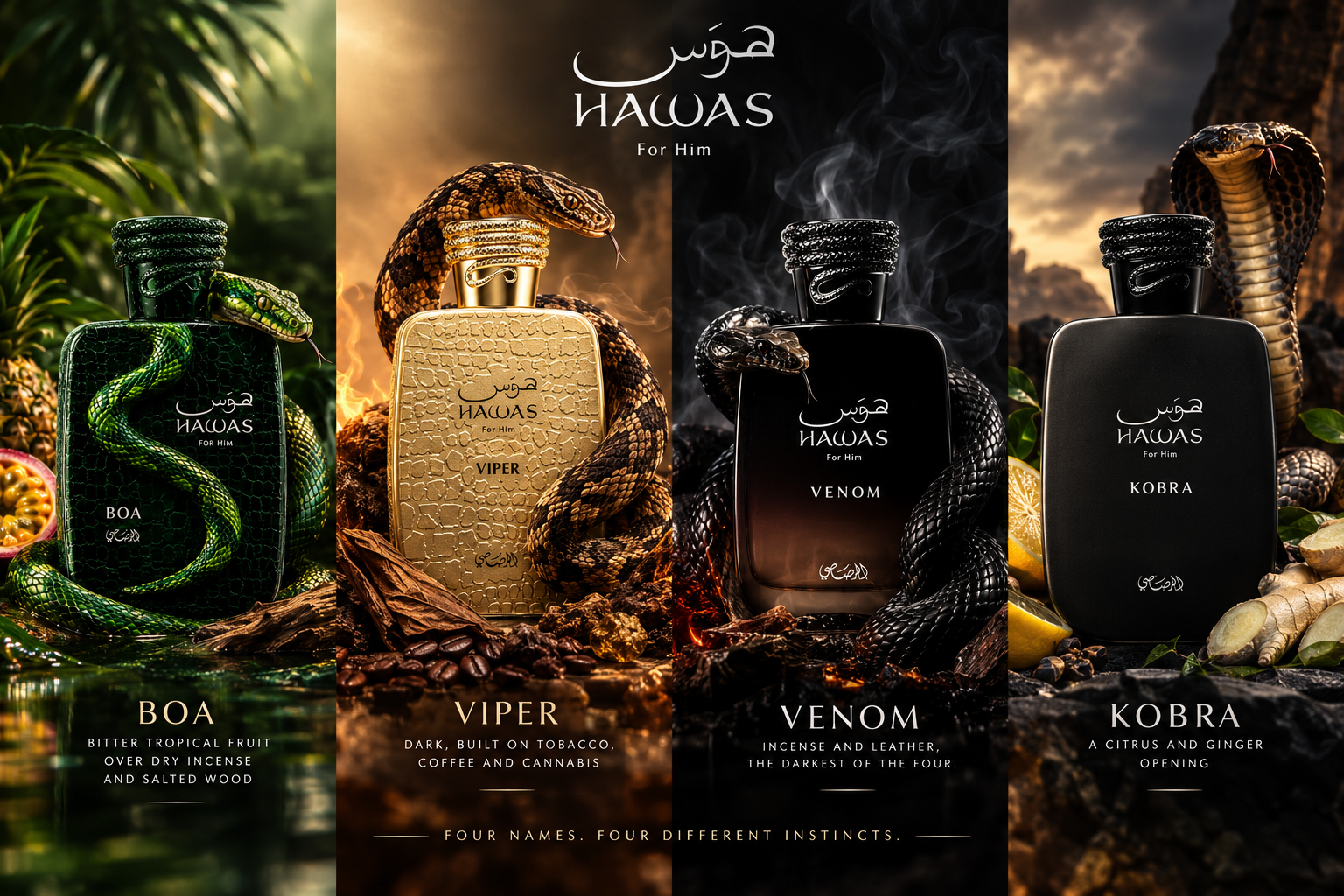
This is where most buyer confusion actually comes from. Rasasi has given four Hawas releases snake names, and people reasonably assume they are a sub-family. They are not related in any way.
Boa is bitter tropical fruit over dry incense and salted wood.
Viper is dark, built on tobacco, coffee and cannabis. It has nothing in common with Boa.
Venom is incense and leather, the darkest of the four.
Kobra is the biggest trap, because the name sounds closest to Boa. It is a citrus and ginger opening with green tea and neroli, over a clean musk and woody base. No fruit, no incense, no vanilla. The only material it shares with Boa is neroli against Boa’s orange blossom, which come from the same tree.
If you were drawn to Boa and thought Kobra would be the companion piece, it is the opposite of one. The snake names signal nothing consistent about what is inside.
The honest criticisms
The line is now very hard to shop, and that is on Rasasi. There are well over thirty Hawas entries in circulation, with sixteen appearing in 2026 alone. Rasasi’s own store carries only nine as core pillars, which means a great many Hawas bottles on sale in the UK are not part of the official range and carry no published pyramid from the brand at all. Kobra is one of them.
Boa is new and the picture is still forming. The original has a decade of wearers behind it. Boa has months. Anyone describing its behaviour across skin types with confidence is guessing.
The bottle oversells the juice. A snakeskin flacon and a name like Boa prepare you for something animalic. You get bright tropical fruit. That mismatch is the single most common complaint.
Published note lists for Boa are frequently truncated. Many listings print the base as vanilla and vetiver only, dropping sandalwood and Ambronova. Those two are doing most of the work after the fourth hour, so a truncated list makes Boa sound far thinner than it is.
Which one should you buy
Buy the original first if you do not own a Hawas yet. It is the reference point for the whole line and the reason the name means anything. Starting with Boa will give you a distorted idea of what Hawas is.
Buy Boa if you already own the original and want the same house going somewhere it has not been. It is the least repetitive flanker in the range and the one least likely to feel like a bottle you already have.
Buy neither on the snake name. If dark and animalic is what you actually want, Viper and Venom are the ones pointed that way, not Boa.
If you want the fruit without the smoke, Sapphire is the nearer option, with guava over orange blossom and sandalwood and no incense in it.
Everything on our shelves
Sold-out bottles are hidden automatically, so what you see here you can order now.
Frequently asked questions
Is Hawas Boa better than the original Hawas?
Neither is better, they are aimed at different things. The original is the more wearable and more universally liked of the two, and it is the safer buy. Boa is the more interesting and the more divisive. If you want one bottle, the original. If you want a second that does not duplicate the first, Boa.
How different is Hawas Boa from Hawas?
Very. They share apple, orange blossom and driftwood, and the overall direction splits completely inside the first hour. The original goes sweet, watery and musky. Boa goes bitter, smoky and dry. Owning one tells you almost nothing about whether you will like the other.
Does Hawas Boa smell like Hawas Kobra?
No, and this is the most common mix-up in the line. Kobra is citrus, ginger, green tea and neroli over clean musk and woods. Boa is tropical fruit over olibanum, driftwood and sandalwood. They are both men’s releases with fresh openings and that is the extent of it. The shared snake name is marketing, not composition.
Is Hawas Boa the only Hawas with incense?
No. Venom is built on incense far more heavily, and London uses the same fruit-over-olibanum structure. Boa is the only one combining prickly pear and pomelo with it, and those two notes appear in no other Hawas.
Is Hawas Boa a limited edition?
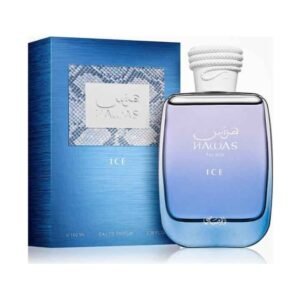
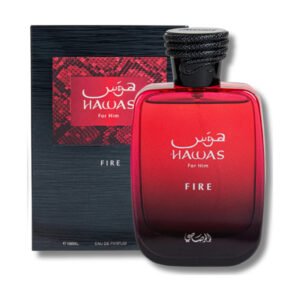
Rasasi lists it as a limited edition, unlike the core pillars in the range such as the original, Ice and Fire.
Which Hawas is closest to Boa?
None of them closely. Sapphire is nearest on the fruity opening thanks to its guava, and London is nearest on structure because it also sets fruit over olibanum. Neither is a substitute.
The verdict
Boa is the flanker in this line that is genuinely trying something, and the gap between it and the original is wider than the shared name suggests. It is not the reinvention some listings claim, since the fruit-over-incense idea already existed inside the range, but the specific combination it runs is its own and the composition holds up.
Treat it as a companion to the original rather than a replacement for it, ignore the snake name entirely, and judge it on a full day of wear rather than a strip test.
Hawas Boa and the original Hawas are both in stock as genuine sealed stock with free UK tracked delivery. For the full breakdown of how Boa wears hour by hour, read our honest Hawas Boa review, and for the range as a whole see every Hawas fragrance compared.


Leave a Reply